explainer · 12 Jul 2026 · 6 min read
So what actually is VDAC1, and why do I care this much?
If you've landed here, you've probably seen me toss around "VDAC1" like everyone knows what it means. Let me fix that. This is the post I wish someone had handed me on day one.
The one-sentence version
VDAC1, the voltage-dependent anion channel 1, is a small protein that forms a pore in the outer membrane of your mitochondria, and it's basically the main doorway between the inside of the mitochondrion and the rest of the cell.
Think of the mitochondrion as a walled power plant. VDAC1 is the front gate. Almost everything the plant ships out or takes in goes through that gate.
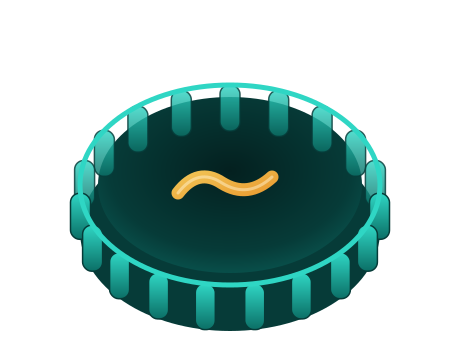
Spin the real thing
That drawing is my cartoon of it. Here's the actual atoms, the crystal structure of human VDAC1 (PDB 2JK4). Drag to rotate, scroll to zoom. The yellow bit is that N-terminal helix that sits inside the barrel and helps gate it.
What it does when everything's fine
Day to day, VDAC1 is a logistics protein, the most abundant one on the mitochondrial outer membrane. It handles the traffic of metabolites (ATP, ADP, NADH, your cell's whole energy economy leans on this), ions (especially calcium, which tunes how hard the mitochondria work), and signals (it's a physical docking point for proteins that decide the cell's fate).
The plot twist: it also helps decide if the cell dies
Here's where it gets interesting, and where my obsession kicks in. VDAC1 isn't just a gate, it's a decision point for apoptosis, programmed cell death.
Under stress, VDAC1 molecules can oligomerize, clump together, and form a much bigger pore than any single channel would. That big pore is a problem, because it lets large things out that are never supposed to leave. Cytochrome c escapes and kicks off the apoptosis cascade. And mitochondrial DNA (mtDNA) escapes, which the immune system treats like an intruder, sensors like cGAS–STING read it as "we've been invaded" and trigger inflammation.
So the same protein that keeps the cell fueled can, when things go sideways, help the cell self-destruct and set off inflammation on the way out. That dual personality is exactly why VDAC1 keeps showing up in disease after disease.
Why this matters for so many diseases
Once you see VDAC1 as "the gate that also throws the self-destruct switch," you start seeing it everywhere, cancer, autoimmune and inflammatory disease, metabolic, heart and kidney disease, and (my main interest) neurodegeneration, where energy-hungry neurons are especially exposed. Flip through the news and you'll notice how many of those beats VDAC1 turns up on.
And that's why the drugs are interesting
If VDAC1 oligomerization is the bad event, then a drug that blocks the clumping without wrecking the normal gate could be genuinely useful. That's the whole idea behind the VBIT compounds (VBIT-4, VBIT-12), which I wrote about over here.
The takeaway: VDAC1 is a tiny, abundant pore that runs your mitochondria's traffic, and under stress can gang up into a bigger pore that helps kill the cell and inflame its neighbours. Keep it working and closed-the-right-way, and a lot of downstream trouble might never start. That's the bet a lot of us are watching.
More about this
Topics in this piece, follow a tag to see everything filed under it: