The short version
I'm a PSEN1 carrier. If you know what that means, you already understand why I read papers the way some people follow sports. If you don't: PSEN1 is one of the genes tied to early-onset familial Alzheimer's. Getting that result rearranges how you think about time, and about the biology underneath it.
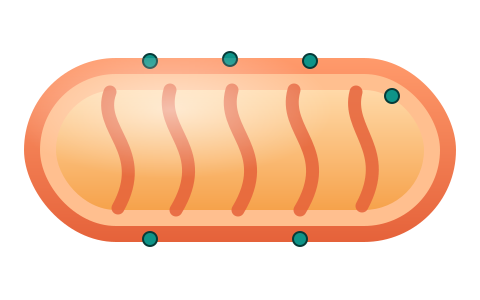
I could have treated it as a countdown. I decided to treat it as a research question instead. That question kept dragging me toward the mitochondria, the tiny power plants inside every one of your cells, and then, very specifically, to one little doorway on their surface: VDAC1.
Why mitochondria, why VDAC1? Mitochondria don't just make energy, they hold the switches for inflammation and cell death too. VDAC1 sits right at the crossroads: metabolites pass through it, calcium passes through it, and when a cell is in trouble it's part of how mitochondria decide to pull the plug. For a disease where hungry neurons slowly fail, that crossroads looks awfully important.
My journey into mitochondrial research
I didn't show up with a PhD and a lab. I showed up with a genetic result, a stubborn streak, and PubMed. I started reading to understand my own risk, and I kept reading because the story kept getting better the deeper I went.
What hooked me was noticing how often the amyloid-centric story of Alzheimer's leaves the energy problem in the footnotes. Neurons are absurdly power-hungry. Mitochondria are how they eat. When mitochondrial quality control slips, when damaged mitochondria leak, when VDAC1 starts oligomerizing and opening pores, when mtDNA ends up where it shouldn't and the immune system panics, you get exactly the slow-burn inflammation and cell loss that neurodegeneration is made of.
So I made it a project: read the primary literature, follow the interesting labs, track the drugs, and turn what I learned into something useful for other people asking the same questions. That's this site.
The co-founder hat
Alongside the reading, I'm a co-founder at x-tosis, a Gainesville, Florida biotech developing first-in-class VDAC1-modulating mitochondrial therapeutics for neurodegeneration (Alzheimer's, Parkinson's, ALS). Yes: the exact mechanism this whole site circles is also my day job. That's not a coincidence, the reading and the building grew out of the same obsession. Working on the company side keeps me honest, too: it's one thing to find a mechanism beautiful in a paper, another to think about what it would actually take to move it toward people.
To be clear about the wall between the two: this site is independent of the company, not a company channel. When x-tosis comes up here, I flag it. Opinions are mine, they're not investment advice, and they are definitely not medical advice.
How the ratings get graded
The Mitochondrial Health Ratings are the part of this site I'm proudest of. Each entry gets three scores: evidence (the quality of human data behind it, from preliminary to strong), benefit (the likely upside for mitochondrial function), and safety. Ratings lean on randomized trials and meta-analyses where they exist, and get labeled "preliminary" honestly when they don't. Every entry links to the research behind it, so you can check my work.
This is a synthesis for orientation, not medical advice. Talk to a clinician before changing anything based on what's here.
What else you'll find
Research news: recent papers summarized in plain words and linked to the source. Resources: the reviews, databases and labs I keep coming back to. And explainers on VDAC1, written for a smart non-specialist, because that's exactly who I was when I started.
I write casually on purpose. It's a passion project, not a journal submission. If I get something wrong, and I will, please tell me. Half the fun is being corrected by people who know more.
Say hi. I genuinely like hearing from people: researchers, fellow carriers, patients, the merely curious. shinaoffer@gmail.com.